
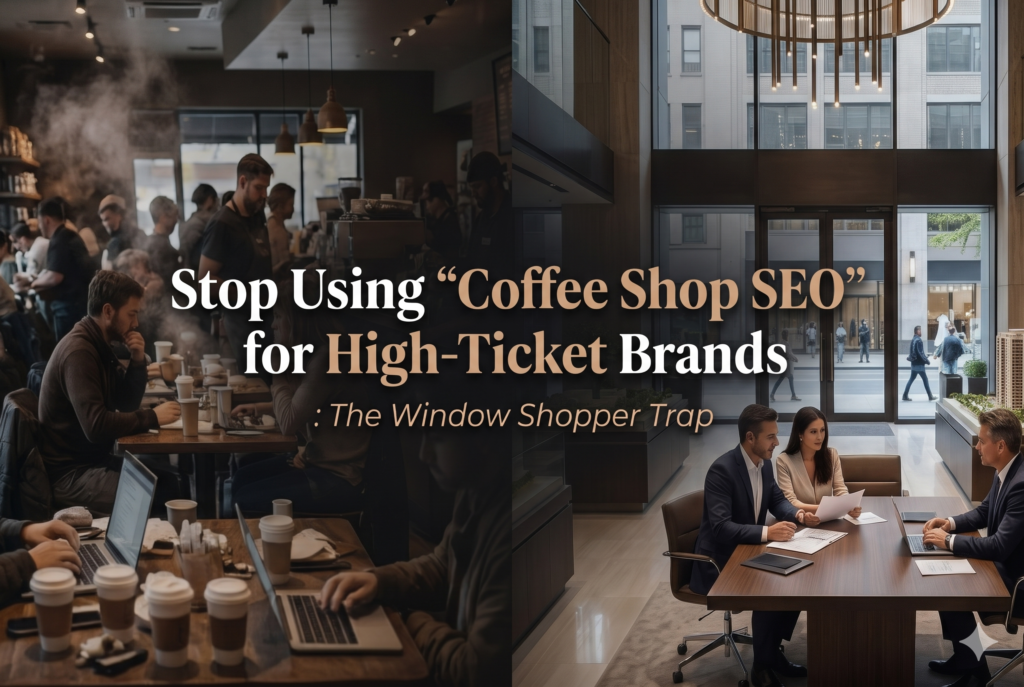
The Window Shopper Trap
Most digital marketing agencies operate on a single, outdated playbook: get as much traffic as possible. They pull up an SEO dashboard, point to a keyword with 50,000 monthly searches, and promise that capturing those clicks will transform your business.
It is a great pitch. But if you sell high-ticket products or premium services, it is a massive liability.
The problem is that most agencies are using a “coffee shop” marketing strategy for brands that operate like private showrooms. A coffee shop survives on massive footfall—thousands of people walking through the door to make a ₹200 purchase. A premium brand does not need crowds. It does not need window shoppers. It needs a handful of highly qualified buyers.
Here is why chasing traditional SEO search volume is actively burning your marketing budget, and how high-ticket brands need to pivot to engineer predictable revenue.
The Cost of the “Search Volume” Trap
High search volume almost always correlates with low commercial intent.
When you optimize your website for broad industry buzzwords just to get traffic, you attract people in the educational or dreaming phase. They are researching a topic, looking for inspiration, or simply comparing prices they cannot afford.
When a premium jeweller in Kerala spends ₹50,000 a month optimizing for broad terms like “gold necklaces,” they aren’t just wasting time—they are actively paying to drive bargain-hunters into a luxury showroom, exhausting their sales team for zero return.
As a performance marketing consultant, I look at organic search through the lens of Conversion Rate Optimization (CRO). In paid Google Ads, we would never bid ₹1,500 a click on a broad, generic keyword because it attracts tire-kickers and destroys the Return on Ad Spend (ROAS). Yet, premium brands willingly spend six
months and thousands of dollars on content to rank organically for those exact same useless terms.
Vanity metrics might look great on an agency report, but window shoppers do not pay payroll.
The “Zero-Volume” Buyer Intent Framework
To scale a high-ticket brand, you must abandon the volume trap and adopt a direct-response approach to search. This means targeting hyper-specific, long-tail queries that mainstream SEO tools flag as having “0 to 10” monthly searches.
Traditional marketers ignore these keywords because the numbers look too small. That is exactly where the money is.
Ask yourself: Would you rather have 10,000 website visitors that result in zero showroom appointments, or 300 highly targeted visitors that result in 12 closed contracts for luxury villas? The math of high-ticket sales requires precision, not volume.
When a prospect types a highly specific, low-volume query into Google, they have already bypassed the awareness phase.They know exactly what they want, and they are actively hunting for a premium solution.
- The Window Shopper Search (High Volume, Zero Intent): “Real estate investments Kerala” or “Gold jewellery designs”
- The Buyer Search (Low Volume, High Intent): “4-bedroom sea-facing luxury apartments in Kozhikode” or “Custom diamond engagement ring designers”
If your core offering is a ₹2 Crore asset or a premium B2B consulting package, you do not need 10,000 website visitors.You only need to capture the exact decision-makers who are ready to make a high-stakes purchase this month.
Why Premium Brands Must Pivot
High-ticket sales require a fundamental shift in funnel architecture. The sales cycle is longer, the trust barrier is immense,and regional premium buyers are researching with more scrutiny than ever before. By targeting low-volume, high-intent keywords, you engineer three immediate advantages:
- Zero Competition: Your competitors are too busy fighting over broad buzzwords to notice the highly lucrative,bottom-of-funnel queries.
- Instant Authority: When a buyer searches for a highly specific requirement and your brand speaks directly to it,you instantly position yourself as a premium specialist, not a generic vendor.
- A Predictable Revenue Engine: Traffic from high-intent keywords converts at exponentially higher rates. You stop treating your website like a digital brochure and start treating it like a 24/7 automated sales representative.
Stop Optimizing for Footfall. Start Optimizing for Revenue.
Stop looking at traditional SEO tools and start looking at your actual buyers. The keywords that drive real revenue are the specific, detailed pain points your best clients articulate right before they swipe a card or sign a contract.
The goal of technical SEO and performance marketing isn’t to generate applause from crowds; it is to engineer a predictable pipeline of qualified leads. By pivoting away from the noise of high-volume buzzwords and embracing the quiet, highly profitable world of buyer intent, you stop competing for window shoppers and start dominating your market.
Ready to stop paying for window shoppers and start engineering predictable revenue? Let’s build a high-ticket growth strategy that scales. Book a Strategy Call today.